

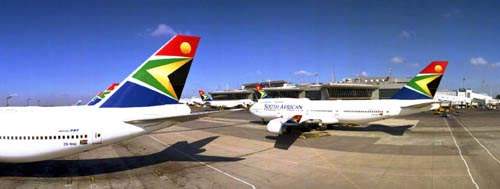
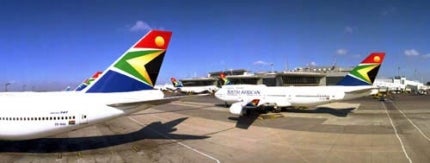
O.R. Tambo International Airport, previously Johannesburg International Airport, is the main airport serving South Africa. It is named after Oliver Tambo, a former president of the African National Congress. The airport is situated at Gauteng, approximately 23km from Johannesburg. It is operated by Airports Company South Africa (ACSA).
Recommended White Papers
Recommended Buyers Guides

The airport is located in the main commercial and industrial hub of South Africa and has excellent transport infrastructure. It is linked with Sandton City in Johannesburg by the Gautrain rapid rail system.
O.R. Tambo handles more than 50% of the country’s air traffic. In 2011-12, the airport handled 19 million passengers with 107,416 aircraft movements. This represents an increase of 1.91% in terms of passenger traffic compared to the previous year.
The airport has been consistently ranked as Best Airport in Africa in Skytrax World Airport Awards. It was extensively expanded and renovated in preparation for the 2010 FIFA World Cup hosted by South Africa.
Terminal
The airport consists of two main Terminals A, B and a Central Terminal Building (CTB) used as a transit between the two terminals. Terminal A handles all international operations and Terminal B handles domestic operations.
The Terminal A building has three levels. The ground level is used for all international arrival operations; level one is used for all international departures; and the mezzanine level is used for both international departure and arrival operations.
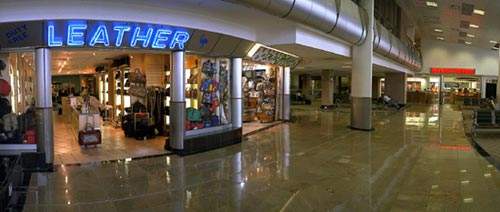
Terminal B building has four levels. Level 0 is used for domestic arrival operations; level one has retail outlets accessible to passengers arriving and departing; level 2 is used for domestic departures and domestic check-in; and level 3 houses several offices and lounges.
The CTB serves as a bridge between the international and domestic terminals.
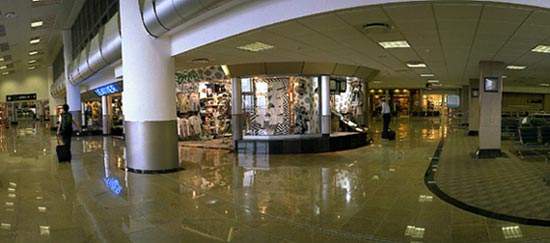
Apart from these terminals, the airport includes a bi-level international pier which can accommodate A380 and includes lounges and duty free stores.
Related project
Cape Town International Airport (CPT/FACT), South Africa
Cape Town International Airport is owned by Airports Company South Africa (ACSA) and is South Africa’s second-largest airport. Situated in the Western Cape, the airport has become the gateway to one of South Africa’s major tourist destinations. Aircraft movements now exceed 90,000 a year.
Airport expansions
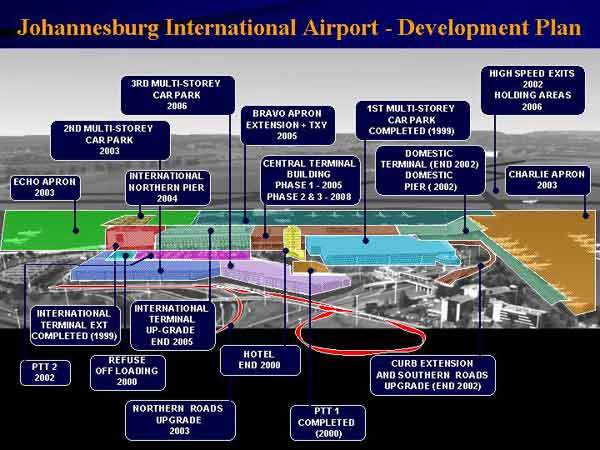
A $50.3m (R450m) domestic terminal which was under construction for two years was completed in February 2003. This was the biggest development project undertaken by the ACSA at that time and was a part of a $83.99m (R750m) expansion project. The terminal has a total floor space of 80,000m2.
The remaining projects in this renovation were – upgrading aprons and road infrastructure near the terminal and extensions to the multi storey parking to increase its capacity to 1,180.
To handle the influx of passengers during the 2010 FIFA World Cup, the airport underwent a massive expansion and renovation. The R5.2bn expansion brought in a new R2.3bn CTB, a R535m International Pier, upgrades to Terminal A departure lounge, a R500m multi-storey parking facility and upper roadway relocation. This expansion increased the capacity of the airport to 28 million passengers per annum.
The first phase of CTB was opened in September 2008. The 18,000m2 facility includes retail stores, a post office and foreign currency exchanges. The construction of Gautrain station at the airport was also completed in the same year. The final phase of the terminal was completed in April 2009. The CTB was officially inaugurated in April 2010.
Around 650 surveillance cameras were installed in the airport as a part of security upgrade programme in preparation for the world cup.
Parking
The airport currently has a parking capacity of 17,500. In 2007, the capacity of the low cost long-term parking bay was increased by 300 spaces to bring its total capacity to 2,400. An R500m multi storey parking extension was completed in March 2009. It increased the capacity of the parking lot to 5,300 spaces. Bay detection technology was installed for passengers to conveniently provide parking information.
Runways
The airport has two runways 03L/21R (4,418m) and 03R/21L (3,400m). The 03L/21R runway is one of the longest international airport runways in the world. This is due to the rarefied atmosphere problem in which fully laden aircraft require a far greater length of runway to achieve take-off velocity at this altitude.
Contractors
The design, planning and management of the expansion and renovation project was provided by Arup. Aurecon was involved in the civil and structural engineering work of the CTB. It installed complex glass and aluminium facade system.
Bentel Associates International was the design business partner for the CTB project. Form-Scaff was the formwork, support work and scaffolding supplier under WBHO/Rainbow Construction/ Lesedi Joint Venture.
