


Quito is the capital of Ecuador and was earlier served by the old Mariscal Sucre International airport covering an area of 150ha. The old airport was completely surrounded by urban development in the middle of the city, with limited scope for expansion to accommodate growing air traffic in Ecuador, which is increasing due to tourism. Ecuador receives more than one million tourists every year and tourism is increasing by 2%-3% a year.
In November 2002, Mariscal Sucre Airport was taken over by a joint venture called Corporacion Quiport SA (Quiport) which comprises Aecon, Andrade Gutierrez Concessoes of Brazil, the Airport Development Corporation of Toronto and HAS Development Corporation of Texas. Aecon is the lead developer of the new airport.
Recommended White Papers

Recommended Buyers Guides

“The new airport was built on a 1,500ha site, which is ten times larger than the old airport and approximately 18km away from the centre of Quito.”
Quiport was awarded the concession to design, build and operate the airport by the City of Quito to replace the old one. It also operated the old airport until it was replaced by the new airport in February 2013.
The new airport is being operated by Quiport under a concession lasting until 2040. The concession provides them the right to collect 80% of the revenue offshore. The new Mariscal Sucre International Airport handled six million passengers, in 2016.
Finance
The total investment for new airport was $700m, which was financed through debt raised from the project lenders. Aecon has a 45.5% economic interest in the airport concession and Andrade Gutierrez Constructores holds a 48% share. The financial closure and start of construction works of the new project occurred in early 2006.
The major lenders to the project are Corporacion Aeropuerto y Zona Franca del Distrito Metropolitano de Quito (CORPAQ), Overseas Private Investment Corporation, Export-Import Bank of the USA and the Inter American Development Bank and Canada’s Export Development Corporation (EDC).
New Quito Airport construction
The old airport was limited in quite a few areas such as the small passenger terminal, the length of the runway, car park, aircraft servicing and cargo facilities.
“New Quito Airport was opened in February 2013.”
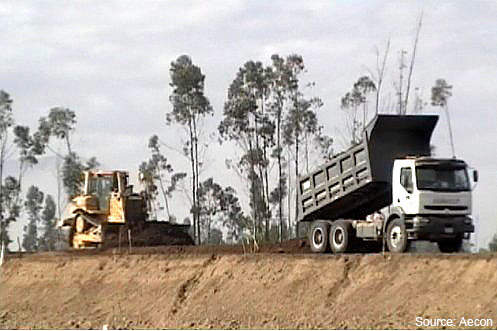
Two-thirds of the project was constructed by 2009. Due to financial disputes among investors, government, and lenders, construction was delayed by 18 months and resumed again in March 2010, finishing in early 2013.
New Quito Airport facilities
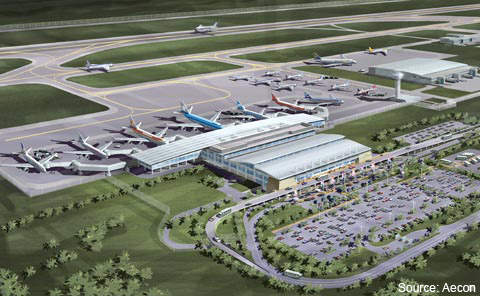
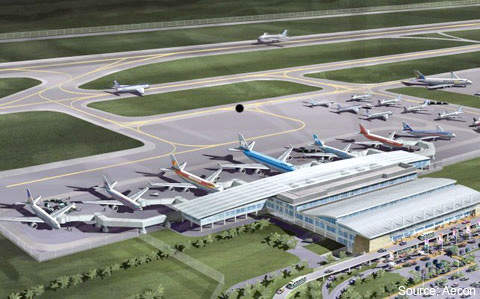
The new airport was built on a 1,500ha site, which is ten times larger than the old airport and approximately 18km away from the centre of Quito.
The air traffic control tower is 41m tall, with the building occupying a site of 901m².
The initial cargo capacity is 250,000t a year, which will eventually increase to 440,000t. The cargo and support area has 10,000m² of storage space and 2,200m² for offices, refrigerated storage and access (bonded) areas, as well as a 5,000m² hangar for maintenance activity. The airport also incorporates a 60ha free-trade business zone to encourage commerce (increasing to 220ha by 2030).
The new airport features the latest passenger and baggage handling solutions comprising the HI-SCAN EdtS automated X-ray screening equipment supplied by Smiths Detection.
Location
The positioning of the new airport on the Caraburo Plateau increases the car journey to the city centre to about 50 minutes but has the advantage of only being at an elevation of 2,400m above sea level instead of 2,808m at the old airport, meaning that passengers won’t find altitude sickness such a problem.
The new airport has a single 4,100m runway. Initially on opening in 2013, the airport was able to accommodate five million passengers a year (76,715 operations a year), which will increase by phased development to 7.5 million by 2030.
Quito City supported the new airport with the construction of a new 4.2km road and a water pipeline to the area where the new terminal building is situated. This infrastructure project has required the purchase of land from 24 farms.
Contractors involved
The new airport was designed by Marshall Macklin and Monaghan of Canada. Avatar Consulting was also involved in the planning. Construction equipment for the new airport was provided by Volecam and Equitransa.
The environmental and social impact assessment for the new airport was carried out by WorleyParsons. The company was also the programme manager for the transition planning and execution to move operations from the old airport to the new airport.